
Vibe Check: Is Your Healthcare Teen Volunteer Program Sigma or Beta?
Published June 17, 2026

This blog is part of a series on Teen/Youth Volunteer Programs in Healthcare. Please see below to explore other resources on this topic.
By Megan Fairchild
Manager, Volunteer Services
Children’s Medical Center Dallas
It’s the moment months of planning have led up to, the first day of your teen volunteer program. The teens are quiet at first, but as conversations pick up, you realize you have no idea what they’re saying. Sigma. Rizz. Skibidi. Ohio (you know that one, but not like this). Bet. No cap. The list goes on. You can’t help but wonder: Are they going to like volunteering here? Is your teen program the GOAT? Will it slay? Will it give you aura points with these teens, patients, visitors, and staff… or are you cooked?
Teen programs aren’t for the faint of heart. They require a tremendous amount of time, energy, and coordination. Managing a teen program is a labor of love as you collect health records, parental consents, interviews, essays, and trainings and do all this while the teens are still in school. Once everything is collected, the work continues, deciding who to accept into a limited number of positions and designing a program that is beneficial to both your organization and the teens themselves.
Years ago, teens often volunteered simply to earn service hours, helping wherever they were needed, but as college admissions grow more competitive, teens are now looking for specific, meaningful experiences that align with future career goals. They want immersion, learning, and insight. The challenge? In pediatric hospitals, teens are often unable to serve in clinical roles due to privacy and confidentiality concerns, as they could easily encounter classmates or peers.
To address this, we’ve taken a multi-pronged approach to creating meaningful teen roles. First, we send out a hospital-wide request asking departments if they need a teen volunteer, with clear guidelines that positions must be non-clinical and focused on customer service or patient experience. Second, we examine open adult volunteer roles that teens can fill. And finally – our favorite part – we get creative. Creativity is where teen programs truly shine.
Our department has developed innovative roles and engagement opportunities that add value while keeping teens interested. At the end of the program, we host a career fair where staff share their educational journeys, career paths, and what a typical day looks like in their role. We’ve also coordinated hands-on learning experiences, behind-the-scenes tours of clinical areas, and interactive workshops tied to areas of interest for the teens. These experiences may not look like “Grey’s Anatomy” or “The Pit,” but they offer something far more realistic – and often more impactful.
As the program concludes, we ask teens to reflect on their experience. Their feedback consistently reminds us why this work matters. Teens have shared that the program helped them understand how hospitals really function, taught them how to approach people going through difficult situations and showed them how something as simple as a smile can brighten someone’s day. Many are surprised by the volume of patients served and the diversity of the hospital population. No matter what path they envision – EVS worker, nurse, child life, physician, or something entirely different – they learn how even small actions contribute to the overall patient experience.
Key takeaways to consider when building or refining a teen program:
- What structure works best for your organization?
- Can you host your teens all at once or split the summer into sessions?
- Do you have enough meaningful roles for full-day experiences, or is half day more realistic?
- Is a one-day-per-week model more effective or an intensive one-week program?
- When identifying roles, aim for experiences that are equally beneficial to both your organization and the teens.
- Think outside the box. Consider adding engagement and learning opportunities in addition to the traditional volunteer roles.
One size does not fit all when it comes to teen programs. Take time to evaluate yours. Is it meeting your needs, or is it simply what you’ve always done?
Ultimately, our goal is for teens to leave wanting to return, whether for future teen programs, college programs, or as adult volunteers or employees. Most importantly, we want them to walk out the doors feeling they learned something valuable, they made a difference in someone’s life, and, hopefully, inspired to come back and work alongside us one day.



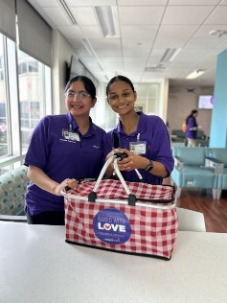
About the Author
Megan Fairchild holds a bachelor’s degree from Brigham Young University and a master’s degree from Arizona State University. In her role as Manager of Volunteer Services and with a passion for improving the patient experience, she has dedicated her career to fostering meaningful connections between hospital staff, volunteers, patients, and patient families. Her expertise lies in creating innovative volunteer programs that support hospital staff and bring comfort and care to young patients and their families.
Explore Other Resources
Blog: Amplifying Youth Voices: The Importance of Direct Pediatric Patient Feedback – The Beryl Institute
Case Study: Modernizing Student Volunteering – The Beryl Institute
Podcast: Turning Teen Volunteers into Healthcare Leaders – The Beryl Institute


Related content
-
Environment & Hospitality | Patient Family & Community Engagement
Transforming the Inpatient Hold Experience Through Partnership
Published April 7, 2026

Discover how collaboration and innovation improved the experience of patients holding in the Emergency Department at Tampa General Hospital. Through PFAC partnership, guest services rounding, volunteer engagement, and technology enhancements, this initiative elevated comfort, communication, and care coordination. Attendees will gain replicable tools to improve experiences in nontraditional care settings. Speakers -Amy Matthews, Manager of
Learn more -
Environment & Hospitality
Temporary Medical Lodging: The Distance Between Home and Here
Published June 22, 2026

By Jenny Owens, ScD, MS Vice Provost of Academic Affairs University of Maryland, Baltimore When we talk about patient experience, the conversation tends to center on what happens inside the hospital. Communication, safety, care transitions, wait times. But for thousands of patients and families who must travel for treatment, the experience begins long before they
Learn more -
Environment & Hospitality
A concept analysis of the patient experience
Published April 27, 2023

Patient experience, an essential indicator of quality patient care, is of increasing importance to hospitals that want to improve and maintain strong patient experience metrics to remain competitive in the business of healthcare. The aim of this study was to clarify the concept of the patient experience by identifying its existing definitions, methods of measurement,
Learn more


