
What We Wear Shapes Patient Trust
Published June 15, 2026

Heather Lazarides, MHA, MS CCC-SLP, CPXP
Director of Patient Experience
BJC Health System
What do patients see before they hear our words or experience our care? The answer is simple: us.
In healthcare, first impressions are formed in seconds, and our research shows that what we wear plays a powerful role in shaping trust, comfort, and confidence during some of life’s most vulnerable moments.
Healthcare organizations often balance employee preference with patient-centered care, and dress standards can feel like a small detail in a complex system. However, our recent patient research revealed that appearance is far from insignificant.
Nearly 70% of patients said employee dress is important, based on a survey of 448 patients, and perceptions of staff, ranging from competence to empathy, shift meaningfully based on attire. As more healthcare organizations embrace casual dress, including the increasingly popular use of branded t‑shirts, it is important to recognize the unintended impact. When standards become inconsistent or lean too casual, it can create uncertainty in moments when patients are seeking clarity, reassurance, and trust.
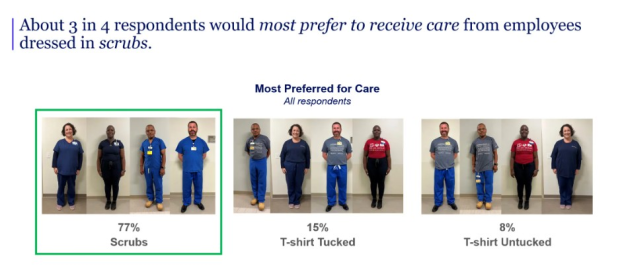

Our findings reinforce that clear, role-based dress standards improve the patient experience:
- Professional clinical attire builds confidence: Patients reported the highest levels of comfort (83%) and were most likely to choose a hospital when staff wore scrubs.
- Perception of key traits improves with polished appearance: Staff dressed in scrubs were more likely to be viewed as knowledgeable, trustworthy, and competent.
- Consistency matters: Even small differences such as tucked vs. untucked shirts statistically significantly impacted perception, reinforcing the importance of uniformity.
This aligns closely with the philosophy in the book, “If Disney Ran Your Hospital: 9 1/2 Things You Would Do Differently.”1 Appearance standards are not about employee preference but about meeting the expectations of those we serve. In environments where people interact face-to-face, every visual cue contributes to the experience.
In healthcare, patients may not remember every clinical detail, but they never forget how they felt in the moment their world changed. A calm presence, a steady voice, and yes, a consistent professional image can become an anchor in uncertainty. It helps patients quickly recognize who is caring for them, easing fear and reinforcing a quiet but powerful message: you are in capable, trusted hands.
But when that consistency falters, even with the best intentions, it can disrupt that fragile sense of trust. Imagine sitting in a room, bracing for life-altering news, and the person delivering it is dressed in a baseball jersey to celebrate the local baseball team’s opening day. In that deeply personal, vulnerable moment, the disconnect is jarring. Instead of feeling grounded, you may feel unsettled. Instead of focusing fully on what matters, your attention is pulled away.
In moments like these, patients aren’t just receiving information. They are searching for reassurance, stability, and something to hold onto. And sometimes, the smallest details become the ones they carry with them long after they leave.
In patient experience, every detail matters and what we wear is one of the first messages we send. By aligning our appearance with patient expectations, we create a more consistent, reassuring, and trustworthy experience. The question isn’t just what we allow, but what our patients need from us in their most important moments.
Key Takeaways:
- Patients use employee dress as a signal for trust, competence, and safety
- Professional and consistent dress increases comfort and confidence
- Scrubs and role-appropriate attire are strongly preferred for clinical care
- Small inconsistencies can create meaningful differences in perception
- Standardization supports clarity, reduces anxiety, and strengthens trust
References:
- Berry, L. L., & Seltman, K. D. (2008). If Disney ran your hospital: 9½ things you would do differently. Second River Healthcare Press.
About the Author
Heather oversees Patient Experience strategy and operations at Barnes-Jewish Hospital, Barnes-Jewish West County Hospital, and the Siteman Cancer Treatment Centers. She has served in various leadership roles in her community, including President of the Missouri Speech and Hearing Association and Director at Large of Programming for the St. Louis Chapter of Healthcare Businesswomen’s Association. She earned her B.S. and M.S. in Speech Pathology from Southern Illinois University Edwardsville and her Master of Healthcare Administration from Webster University


Related content
-
Environment & Hospitality | Patient Family & Community Engagement
Where Are My Things? Best Practices for Safeguarding Patient Belongings in Hospitals
Published January 25, 2024

Managing patient belongings is a persistent and complex challenge faced by nearly all hospitals and healthcare systems. When personal items are misplaced or lost during a patient’s hospital stay, the consequences go beyond inconvenience. Financially, hospitals may be liable for compensation or replacement of lost items, and operational resources are often diverted to investigate and
Learn more -
Environment & Hospitality
Temporary Medical Lodging: The Distance Between Home and Here
Published June 22, 2026

By Jenny Owens, ScD, MS Vice Provost of Academic Affairs University of Maryland, Baltimore When we talk about patient experience, the conversation tends to center on what happens inside the hospital. Communication, safety, care transitions, wait times. But for thousands of patients and families who must travel for treatment, the experience begins long before they
Learn more -
Environment & Hospitality
Maximizing the Wait: 4 Ways to Transform Lost Time in Medical Facilities into Patient Engagement
Published April 7, 2025

By Lauren K. Janney, Co-Founder/Chief People Officer at CXPerks For most patients, the waiting room experience in a medical facility is synonymous with frustration. Whether it’s a routine check-up or an emergency visit, the wait time often feels like lost time—an unavoidable delay in an already stressful situation. It is suggested that nearly 20%
Learn more


